Taiwanese Mandarin vs Mainland Mandarin: Vocabulary, Pronunciation and Characters
Compare Taiwanese and Mainland Mandarin with everyday vocabulary, audio examples, character differences and practical advice on choosing what to learn.
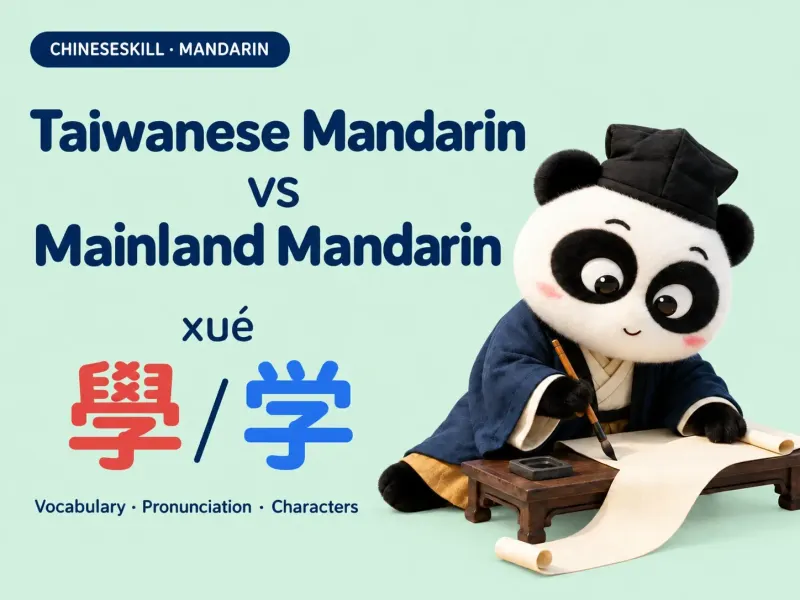
Taiwanese Mandarin and Mainland Mandarin are varieties of the same language. They share most of their grammar and vocabulary, so learning one gives you a strong foundation for understanding the other. The differences you will notice most are everyday word choices, some pronunciations, and the characters and pronunciation guides used in learning materials.
Perhaps you've started a Mandarin course and then booked a trip to Taiwan. Or your partner's family speaks Taiwanese Mandarin, while your textbook teaches Mainland Mandarin. Did you pick the wrong course? No. You have useful Chinese already; now you can adapt it to the people you want to talk to.
This guide compares the words, sounds and writing systems side by side, then helps you choose a starting point. You don't have to master every difference before your first conversation.
The short answer
Choose the Mandarin variety that fits your life; most of what you learn will carry over.
Swipe the table to compare all columns.
| What changes? | Taiwan | Mainland China |
|---|---|---|
| Everyday communication | Mandarin speakers can generally understand each other | Mandarin speakers can generally understand each other |
| Usual writing system | Traditional characters | Simplified characters |
| Pronunciation guide taught to children | Zhuyin, also called Bopomofo | Hanyu Pinyin |
| Vocabulary | Some distinctive everyday terms | Some different terms, with regional variation |
| Pronunciation | Taiwan's reference readings, plus local accents | Putonghua reference readings, plus local accents |
| Proficiency test often relevant to learners | TOCFL | HSK |
A useful comparison is American and British English: different words and accents, with plenty in common. It's an analogy, not an exact match. Mandarin also has two character systems to get used to, and neither Taiwan nor mainland China has just one accent.
Can Taiwanese and mainland speakers understand each other?
Mandarin speakers from Taiwan and mainland China can generally communicate without switching languages, though unfamiliar vocabulary and accents can take some adjustment.
A conversation about dinner or weekend plans usually draws on shared Mandarin. Fast speech, regional expressions or unfamiliar topics may make it harder—especially when you're still learning. Needing someone to repeat a word doesn't mean you learned the wrong variety.
For a memorable example, look at 土豆 (tǔdòu). It means “potato” in mainland usage, but can refer to a peanut in Taiwan. The Taiwan Ministry of Education's dictionary entry records both meanings. For “potato” in Taiwan, learn 馬鈴薯 (mǎlíngshǔ); for “peanut,” 花生 (huāshēng) is a useful, unambiguous word.
That's a vocabulary adjustment, not a reason to start over. Written messages add a separate challenge: knowing a spoken word doesn't automatically mean you can recognize its unfamiliar Traditional or Simplified form.
Vocabulary differences
The most useful word differences for beginners turn up in ordinary tasks: catching a bus, ordering lunch or sending a message.
These 33 pairs are selected from the Ministry of Education's cross-strait vocabulary table. Each linked Taiwan entry takes you to the relevant source page. The table offers equivalents, not a survey of how often everyone uses them; several words appear on both sides.
We use Traditional characters for Taiwan and Simplified characters for mainland China. Both columns include Pinyin so you can compare them without learning a new notation first. Learn the words you need to say, and treat the other column as recognition practice.
Transport and city life
Swipe the table to compare all columns.
| English | Taiwan | Mainland China | Notes |
|---|---|---|---|
| taxi | 計程車 jìchéngchē | 出租车 chūzūchē | Names vary locally; this is a useful starting pair |
| bus | 公車 gōngchē | 公共汽车 gōnggòng qìchē | You will also see 公交 (gōngjiāo) |
| bus stop | 公車站 gōngchē zhàn | 公交站 gōngjiāo zhàn | |
| scooter, motorbike | 機車 jīchē | 摩托车 mótuōchē | For a scooter or motorcycle |
| bicycle | 腳踏車 jiǎotàchē | 自行车 zìxíngchē | 單車 / 单车 (dānchē) is another shared option |
Food
Swipe the table to compare all columns.
| English | Taiwan | Mainland China | Notes |
|---|---|---|---|
| potato | 馬鈴薯 mǎlíngshǔ | 土豆 tǔdòu | 土豆 (tǔdòu) can mean peanut in Taiwan |
| tomato | 番茄 fānqié | 西红柿 xīhóngshì | 番茄 (fānqié) is also used in mainland China |
| pineapple | 鳳梨 fènglí | 菠萝 bōluó | A basic translation pair, not a guide to varieties sold in shops |
| kiwi fruit | 奇異果 qíyìguǒ | 猕猴桃 míhóutáo | |
| tuna | 鮪魚 wěiyú | 金枪鱼 jīnqiāngyú | |
| instant noodles | 泡麵 pàomiàn | 方便面 fāngbiànmiàn | 泡面 (pàomiàn) is also a mainland option |
| cabbage | 高麗菜 gāolícài | 卷心菜 juǎnxīncài / 圆白菜 yuánbáicài | Names vary by region in the mainland |
| boxed meal | 便當 biàndāng | 盒饭 héfàn | |
| late-night snack | 宵夜 xiāoyè | 夜宵 yèxiāo | Same characters, flipped order |
| ice cream | 冰淇淋 bīngqílín | 冰激凌 bīngjīlíng | 冰淇淋 (bīngqílín) is also a mainland spelling |
Tech and the internet
Swipe the table to compare all columns.
| English | Taiwan | Mainland China | Notes |
|---|---|---|---|
| software | 軟體 ruǎntǐ | 软件 ruǎnjiàn | |
| video (online) | 影片 yǐngpiàn | 视频 shìpín | |
| internet, network | 網路 wǎnglù | 网络 wǎngluò | |
| text message | 簡訊 jiǎnxùn | 短信 duǎnxìn | |
| computer mouse | 滑鼠 huáshǔ | 鼠标 shǔbiāo | |
| USB flash drive | 隨身碟 suíshēndié | U盘 U pán | |
| printer | 印表機 yìnbiǎojī | 打印机 dǎyìnjī | |
| blog | 部落格 bùluògé | 博客 bókè | |
| computer program | 程式 chéngshì | 程序 chéngxù | |
| information | 資訊 zīxùn | 信息 xìnxī |
Everyday words
Swipe the table to compare all columns.
| English | Taiwan | Mainland China | Notes |
|---|---|---|---|
| quality | 品質 pǐnzhí | 质量 zhìliàng | 品质 (pǐnzhì) is also used in mainland China |
| level, standard | 水準 shuǐzhǔn | 水平 shuǐpíng | |
| ballpoint pen | 原子筆 yuánzǐbǐ | 圆珠笔 yuánzhūbǐ | |
| to print | 列印 lièyìn | 打印 dǎyìn | |
| private room (KTV, restaurant) | 包廂 bāoxiāng | 包间 bāojiān | |
| security guard | 保全 bǎoquán | 保安 bǎo'ān | |
| homeroom teacher | 班導師 bāndǎoshī | 班主任 bānzhǔrèn | |
| electric cooker / rice cooker | 電鍋 diànguō | 电饭煲 diànfànbāo | Useful household terms; the appliances need not have identical functions |
Start with five pairs you can use this week. If you're visiting Taiwan, being able to ask for a taxi and recognize a bus stop will help more than memorizing every technology term in one sitting.
Pronunciation differences
Separate differences in a word's reference pronunciation from differences in a speaker's everyday accent.
A dictionary can tell you which tone to practise in a course. It cannot tell you exactly how every person in Taipei, Shanghai or Beijing speaks. Keep that distinction in mind when comparing the following examples.
Same word, different reference reading
The Taiwan column below follows the Ministry of Education's Concised Mandarin Chinese Dictionary. The mainland column follows the readings in the Ministry of Education's 2010 graded vocabulary reference. These are pronunciation references, not a claim that everyone uses these forms in conversation.
Swipe the table to compare all columns.
| Word | English | Taiwan reference | Mainland reference |
|---|---|---|---|
| 垃圾 | garbage | lèsè Listen |
lājī Listen |
| 星期 | week | xīngqí Listen |
xīngqī Listen |
| 研究 | research; to study | yánjiù Listen |
yánjiū Listen |
| 危險 / 危险 | dangerous | wéixiǎn Listen |
wēixiǎn Listen |
| 企業 / 企业 | enterprise; company | qìyè Listen |
qǐyè Listen |
| 暫時 / 暂时 | temporarily | zhànshí Listen |
zànshí Listen |
| 綜合 / 综合 | to combine; comprehensive | zònghé Listen |
zōnghé Listen |
| 攜帶 / 携带 | to carry | xīdài Listen |
xiédài Listen |
| 說服 / 说服 | to persuade | shuìfú Listen |
shuōfú Listen |
| 頭髮 / 头发 | hair | tóufǎ Listen |
tóufa Listen |
Many differences involve just one tone, although lèsè and lājī sound more noticeably different. For your own speech, follow your course's target pronunciation consistently. For listening, learn to recognize alternatives rather than treating them as mistakes.
The zh, ch and sh sounds
The sounds written zh, ch, sh are produced farther back in the mouth than z, c, s. They are often called “retroflex” sounds. You may hear a clearer distinction in careful teaching speech and a smaller distinction in some casual Taiwanese Mandarin.
That doesn't mean you should replace every sh with s. Taiwan speakers vary, and mainland speakers vary too. Research on Taiwan Mandarin shows that the same speaker's pronunciation can change with the situation. Practise hearing and producing the contrast before trying to imitate a particular accent.
Erhua: the “r” ending
In Beijing and some other northern mainland speech, you will hear an “r” sound attached to certain syllables. For example, 一点儿 (yìdiǎnr) means “a little,” and 哪儿 (nǎr) means “where.” This feature is called erhua.
For “where,” 哪裡 / 哪里 (nǎlǐ) is a useful alternative, particularly when learning for Taiwan. Erhua is less prominent in Taiwanese Mandarin, but it also varies across mainland regions; “Mainland Mandarin” doesn't mean that everyone sounds like a Beijinger. This phonetics overview discusses variation both between and within Mandarin varieties.
Full tones and the neutral tone
A neutral-tone syllable is normally shorter and less prominent than a full-tone syllable. It still has pitch, but its pitch depends on the surrounding speech. In Pinyin, it has no tone mark.
Some words have a full final tone in Taiwan dictionary entries where mainland references use a neutral tone:
Swipe the table to compare all columns.
| Word | English | Taiwan reference | Mainland reference |
|---|---|---|---|
| 朋友 | friend | péngyǒu Listen |
péngyou Listen |
| 時候 / 时候 | time; moment | shíhòu Listen |
shíhou Listen |
| 先生 | Mr.; husband | xiānshēng Listen |
xiānsheng Listen |
Listen for the rhythm as well as the tone. This is not a rule that Taiwan speakers give every syllable a full tone: unstressed syllables and conversational variation exist in both varieties.
Characters and phonetic systems
Traditional and Simplified are character systems; Zhuyin and Pinyin are ways to show pronunciation.
Keeping those jobs separate makes this topic much easier. A character tells you which written word you're looking at. A pronunciation guide helps you say it. Traditional characters can be paired with Pinyin, just as we do in this article.

Traditional vs Simplified characters
Taiwan generally uses Traditional characters, while mainland China generally uses Simplified characters. Here are some useful pairs:
Swipe the table to compare all columns.
| English | Traditional | Simplified | Pinyin |
|---|---|---|---|
| to study | 學 | 学 | xué |
| body | 體 | 体 | tǐ |
| to speak | 說 | 说 | shuō |
| dragon | 龍 | 龙 | lóng |
| book | 書 | 书 | shū |
| car | 車 | 车 | chē |
| love | 愛 | 爱 | ài |
| door | 門 | 门 | mén |
Many characters—including 人 (rén, person) and 我 (wǒ, I)—are identical. Others have recurring component changes: compare 說 / 说 (shuō, to speak) and 話 / 话 (huà, speech).
Some Simplified forms also combine distinctions kept in Traditional writing. For instance, 發 in 發現 (fāxiàn, to discover) and 髮 in 頭髮 (tóufǎ in Taiwan's reference reading, hair) both become 发. Context helps you recognize the right word.
Traditional forms often have more strokes, but that alone doesn't determine how easy they are for you to learn. Choose the script you'll read most, then learn common correspondences when you need the other. Our Chinese characters guide introduces how characters are built.
Zhuyin (Bopomofo) vs Pinyin
Pinyin uses the Latin alphabet; Zhuyin uses 37 symbols, along with tone notation. Both represent Mandarin pronunciation. The nickname Bopomofo comes from Zhuyin's first four symbols: ㄅ ㄆ ㄇ ㄈ (b, p, m, f).
Swipe the table to compare all columns.
| Character and meaning | Pinyin | Zhuyin |
|---|---|---|
| 媽 / 妈 — mother | mā | ㄇㄚ |
| 麻 — hemp | má | ㄇㄚˊ |
| 馬 / 马 — horse | mǎ | ㄇㄚˇ |
| 罵 / 骂 — to scold | mà | ㄇㄚˋ |
In the usual Zhuyin notation shown here, first tone has no written tone mark. You can explore the symbols in the Ministry of Education's Zhuyin manual.
Children in Taiwan learn Zhuyin, and it is useful for local dictionaries, beginner reading materials and typing. But you can start learning Taiwanese Mandarin with Pinyin. Taiwan's official romanization guidance also uses Hanyu Pinyin; that doesn't make every place name or personal name follow the same spelling system.
Typing
Your pronunciation input and your output script are separate choices. A Pinyin keyboard can produce Traditional characters, and a Zhuyin keyboard is another option for writing Mandarin. Check the input method and character settings on your device; our Chinese typing guide is a starting point.
Grammar and particles
Most beginner grammar carries over, but some conversational constructions and sentence endings deserve their own examples.
有 before a verb
In Taiwanese Mandarin conversation, 有 (yǒu) can appear before a verb to affirm that an event happened. You might hear:
Swipe the table to compare all columns.
| Taiwan conversational example | A common mainland alternative | English |
|---|---|---|
| 我有去過。 Wǒ yǒu qù guò. Listen |
我去过。 Wǒ qù guo. Listen |
I've been there. |
| 你有吃飯嗎? Nǐ yǒu chī fàn ma? | 你吃饭了吗? Nǐ chī fàn le ma? | Have you eaten? |
The English “I did go” can help you understand the confirming effect in some contexts. But yǒu is not a general translation of English “did,” and these alternatives need not have exactly the same emphasis. Don't add it before every past event. Research on this construction describes uses beyond simple past time.
The examples are useful patterns to recognize in conversation, not a claim that the construction is exclusive to Taiwan.
Little words at the end of a sentence
In casual Taiwanese Mandarin, you may hear endings such as 喔 (o), 啦 (la) and 耶 (ye). These are particles: short words that help express the speaker's attitude. Their pitch and effect depend on the conversation, so the unmarked spellings here are listening cues, not a prescription for one fixed tone.
- 好喔! (Hǎo o!) — “Okay!” This can sound like a friendly acknowledgment.
- 不要啦! (Bú yào la!) — “No, I don't want to!” It may sound playful or protesting, depending on delivery.
- 好可愛耶! (Hǎo kě'ài ye!) — “That's so cute!” The ending can add an expressive, noticing quality.
Don't think of these as automatic politeness buttons. The same words can sound warm, impatient or sarcastic with different intonation. Learn whole expressions from a conversation you understand, including who is talking to whom. Research on particles in teaching conversations also highlights the role of the relationship between speakers. Mainland Mandarin has sentence-final particles too; the difference is not their presence versus absence.
Taiwanese Mandarin, Taiwanese Hokkien and Cantonese
Taiwanese Mandarin is a variety of Mandarin; Taiwanese Hokkien and Cantonese are different spoken languages within the Chinese language family.
Taiwanese Mandarin is often called 國語 (Guóyǔ) or 華語 (Huáyǔ). It is the Mandarin this guide compares with mainland Putonghua (普通话, Pǔtōnghuà).
Taiwanese Hokkien, often called 台語 (Táiyǔ in Mandarin), is what people frequently mean by “Taiwanese.” Knowing Mandarin alone does not make Hokkien conversation intelligible. If you're learning to talk with family, ask which language they actually use at home.
Cantonese, or 粵語 / 粤语 (Yuèyǔ in Mandarin), is widely spoken in Hong Kong and parts of southern China. Don't use the writing system to identify the spoken language: Traditional characters are used in Hong Kong, while Cantonese speakers in mainland China generally use Simplified characters.
If someone says “I'm learning Taiwanese,” asking “Mandarin or Hokkien?” can save you both some confusion.
Which one should you learn?
Choose a starting variety by the people, places and materials you want to understand.
Swipe the table to compare all columns.
| Your main goal | A useful starting point | Why |
|---|---|---|
| Living, studying or working in Taiwan | Taiwanese Mandarin | Local word choices and Traditional reading materials |
| Talking with Mandarin-speaking family from Taiwan | Taiwanese Mandarin | Matches the conversations you want to join |
| Living, studying or working in mainland China | Mainland Mandarin | Local vocabulary and Simplified reading materials |
| Preparing for HSK | Materials for your HSK level and test version | Familiarity with the actual exam matters |
| Preparing for TOCFL | TOCFL materials, alongside your Mandarin course | Practise the test's listening and reading tasks |
| No fixed destination yet | Either variety | Choose a course and content that keep you interested |
Can you switch later? Yes. You keep your grammar foundations and much of your vocabulary. Expect to practise unfamiliar character forms, regional words and listening habits. You are adding to your Chinese, not throwing it away.
You can also learn from both varieties. As a beginner, choosing one main course gives you a consistent model for pronunciation and spelling; shows, music and conversations from elsewhere can widen your listening experience.
For a structured start, explore ChineseSkill's Taiwan Mandarin course or Mainland Mandarin course, depending on your goals.
TOCFL vs HSK
Choose the certificate your intended school, scholarship or employer accepts, then prepare for that specific exam.
TOCFL is administered by Taiwan's Steering Committee for the Test of Proficiency–Huayu. Its listening and reading framework includes Novice and Bands A, B and C, with eight levels in total. Don't assume every test component has the same format or level options.
Learning Simplified characters doesn't automatically rule TOCFL out: its official practice resources include Traditional and Simplified versions. Check the arrangements for your chosen test session.
HSK is a standardized Chinese proficiency test, with registration information, syllabuses and sample questions on the official Chinese Tests Service website. Check which syllabus and format apply to your booked test, rather than assuming every resource labelled “HSK” describes the same version.
Neither exam requires you to abandon what you already know. The practical question is which vocabulary, script options and tasks you need to practise for your application.
How to learn Taiwanese Mandarin
Use a consistent pronunciation model, practise useful local words, and listen to short conversations you can understand.
- Learn sounds in words. Use your course's recordings and repeat a short phrase. For tone basics, see our Chinese tones guide.
- Add Zhuyin when it serves your goal. It's especially useful for Taiwan learning materials and keyboards. If Pinyin is already helping you, keep using it while you learn the new symbols.
- Turn the comparison table into something you can say. Pick a task—taking a taxi, ordering lunch—and practise a sentence with the relevant word. Then listen for that word in real conversation.
ChineseSkill's Taiwan Mandarin course offers a structured option. Its App Store release notes describe around 300 lessons, tone and Zhuyin practice, handwriting exercises and spaced-repetition review: practice that brings material back over time. Use a course for structure and conversations for experience; they help in different ways.
FAQ
Is Taiwanese Mandarin different from Mainland Mandarin?
Yes, but both are Mandarin, and most beginner grammar and vocabulary carry over. The main differences involve some everyday words, certain reference pronunciations, local accents, and the characters and pronunciation guides used in teaching. Neither label describes exactly how every individual speaks.
Can Taiwanese and mainland Chinese speakers understand each other?
Mandarin speakers can generally understand one another across Taiwan and mainland China. Unfamiliar accents, regional expressions and fast speech may still require clarification. For learners, reading the other character system is a separate skill; being able to follow a conversation doesn't guarantee you can read every message.
Is Taiwanese Mandarin simplified or traditional?
Taiwan generally uses Traditional characters, while mainland China generally uses Simplified characters. These are writing conventions, not separate spoken languages. Many characters are shared, and others have recognizable correspondences. Start with the script you'll use most, then build recognition of the other when you need it.
Do people in Taiwan use Pinyin?
Yes, Pinyin has uses in Taiwan, including official romanization and some learning materials. Children generally learn pronunciation with Zhuyin instead. If you're learning Taiwanese Mandarin, you can start with Pinyin and add Zhuyin for local resources or typing. Traditional characters do not require one particular pronunciation notation.
Should I learn Taiwanese or Mainland Mandarin?
Start with the variety that matches your main conversations and reading. Taiwan-focused learners will benefit from Taiwanese Mandarin and Traditional characters; mainland-focused learners will benefit from Mainland Mandarin and Simplified characters. If an exam is your goal, choose materials for that test. You can broaden your skills later.
Is Taiwanese Mandarin easier to learn?
Neither variety is automatically easier for every learner. Your background, available teaching materials and opportunities to practise matter. Some Traditional forms have more strokes, but stroke count alone doesn't determine learning difficulty. Choose the variety you're motivated to use, and build pronunciation, vocabulary and reading together.
Is “Taiwanese” the same as Taiwanese Mandarin?
Not necessarily. “Taiwanese” often refers to Taiwanese Hokkien, which is a different spoken language from Mandarin. Taiwanese Mandarin is the variety of Mandarin used in Taiwan. If you're choosing a course to speak with family or friends, ask which language they use before deciding what to study.
Should I take the TOCFL or the HSK?
Take the exam accepted by your intended school, scholarship or employer. TOCFL is administered in Taiwan; HSK is offered through the Chinese Tests Service system. Confirm the required level, accepted test components and arrangements for your session. Don't choose solely by the character system you first learned.